

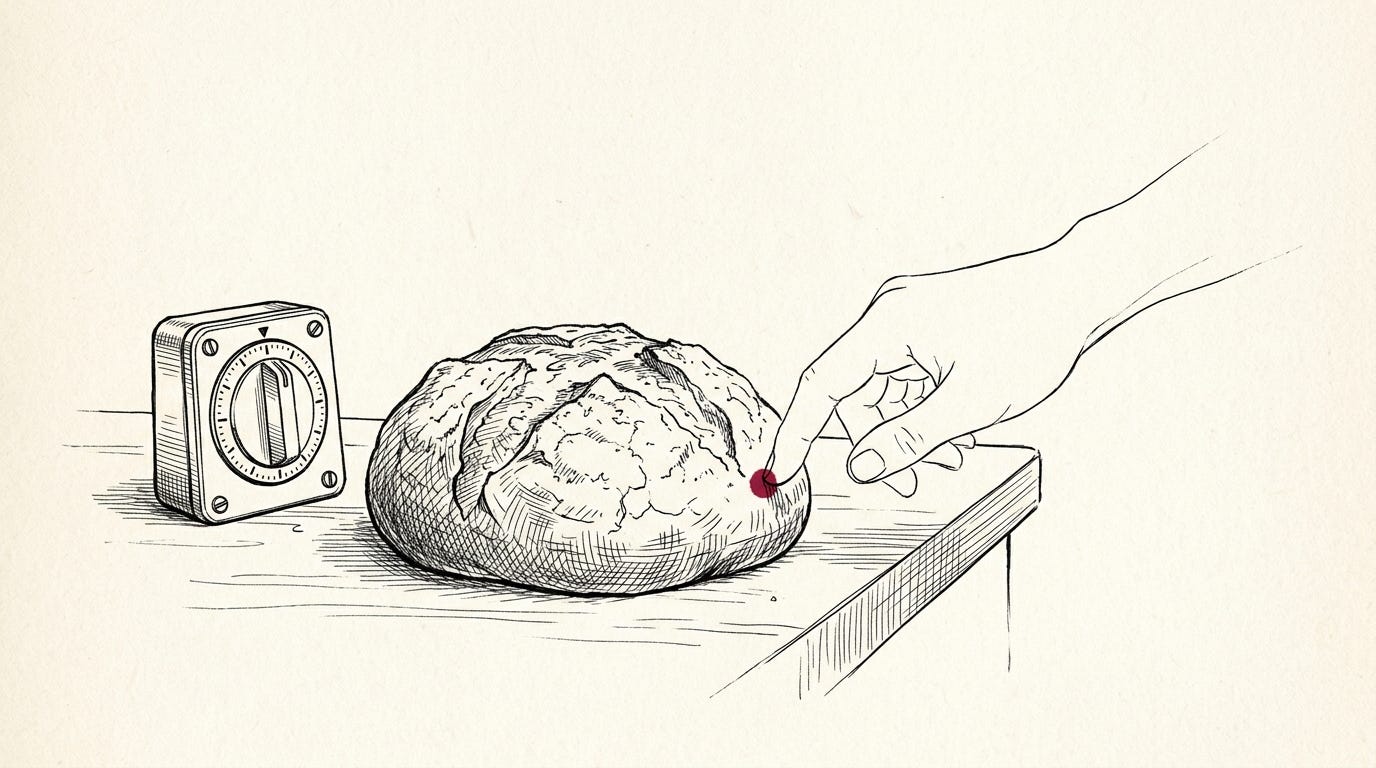
An old bread recipe says: bake until the loaf smells right and sounds hollow when you knock on it. A new one says: 450 degrees, 45 minutes. The second sounds more precise and measures worse. Knocking tells you about the bubbles in the crumb; the timer only guesses at them.
The old recipe still looks primitive. It asks for experience. The new one asks for nothing.
Thirty years ago, Theodore Porter explained why the worse measurement wins anyway: numbers travel. Qualitative information needs shared background, so it stays where it was made. What makes a piece of information portable is subtraction, and the first thing subtracted is whatever can’t be read without skill.
That is what makes the numerical entrance so easy. If you are starting out, you need to bring nothing at all.
The standard critique: metrics destroy the quality they were meant to measure. C. Thi Nguyen has just written a book about it and calls the phenomenon value capture: the simplified version of what matters to you gradually replaces the original.
Except he is his own best counterexample. Nguyen found his feel for elegant movement through the climbing grade scale, and without it he would never have started. The scale was the door.
What the number takes is not the path. It is the view of it. If all you know is the scale, you have no reason to suspect that anything lies beyond it.
So the question is no longer whether to measure. It is who brings the number back.
Anders Ericsson’s work on deliberate practice requires an objective performance measure for expertise, which sounds like the opposite of everything above. But in that model someone is always standing next to you: a coach who translates the qualitative standard into a number when a number is needed, and dissolves it again afterwards. The metric lasts an afternoon. It does not stay.
Call that role the interpreter.
Interpreting does not scale. It takes someone who knows the craft, knows the situation and has the time; the cost grows with every case. A metric costs setup once and almost nothing after that, covers a thousand cases at once, and compares across sites and years.
So when an organisation grows, the interpreter goes first. Not out of stupidity. He is the most expensive part of the system and the only one whose absence nobody notices right away. The numbers keep coming.
The Uber driver is deactivated below roughly 4.6 stars, the threshold varying by city, and nobody asks him what kind of week he had. The teacher gets the class through the test. The developer closes tickets.
Yale Law School demonstrated the way out in 2022 and showed how narrow it is. It withdrew from the U.S. News ranking, saying it had invested significant resources in initiatives that make the school better and perversely lower its own score. Harvard, Stanford, Berkeley, Columbia and Georgetown followed within days. All of them sat near the top of the list they were leaving.
If you no longer need the number, you can give it up. A school in the middle of the pack cannot; for them, walking away is self-harm.
Which leaves the interpreter, not an exit but maintenance while the machine keeps running.
So whoever introduces a metric should say in the same breath who is allowed to dissolve it. Not who collects it, monitors it and puts it on the dashboard, but who is authorised to say, in a specific case, that the number does not fit here, and whose judgement then counts.
If that person does not exist, the metric is not an entrance. It is the destination.