

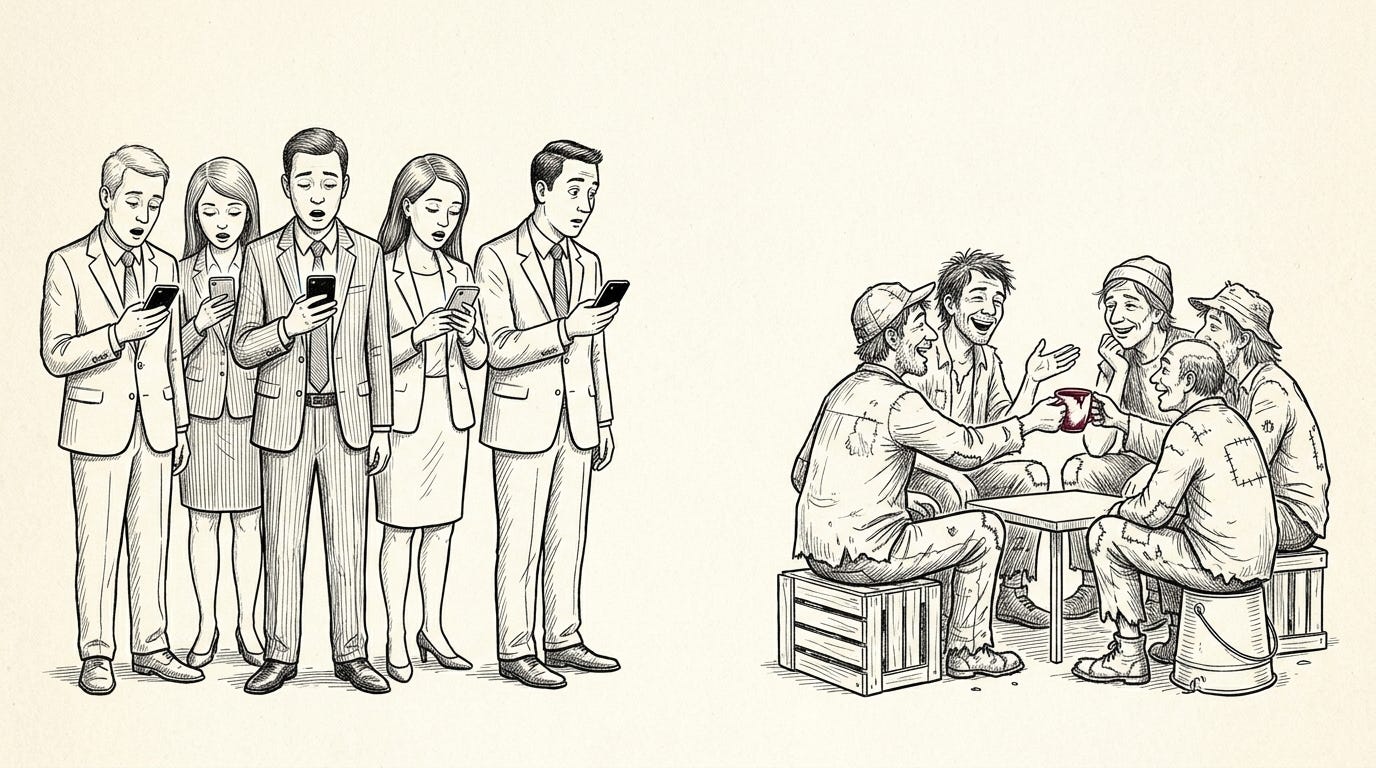
Elon Musk promises a utopian future in which nobody has to work. Meanwhile, the United States is debating a basic income, because a lot of people will foreseeably not find work anymore, and people are protesting outside data centers because they drive up electricity prices. By American standards, these are near-revolutionary conditions.
Utopia, basic income, revolution: the words sound like vocabulary from another era, and the vocabulary does come from there. A class, for Marx, is a group of people who occupy the same position in the economy, top or bottom. Today the class line no longer runs between owning and not owning, but between being needed and not being needed. Yuval Harari calls the second group the useless class. I would suggest distinguishing between the Relevant and the Redundant: present, not necessarily useless, but without a function in the economic system.
The proletariat of the twentieth century could strike. It could stop the wheels, and everyone knew it. The Redundant can demonstrate. But who listens to someone they don’t need? A strike of the superfluous goes unnoticed, and whoever isn’t heard falls silent. Industrial rationalization took manual labor off the worker’s hands. AI takes his voice. What gets rationalized away is the effort of understanding a human being.
The two largest prompting courses on Coursera have 1.4 million enrollments between them; Wharton’s communication course has 195,000. The AI colleague is always available, answers instantly, and reads well. The human colleague takes longer, talks around the point, and has bad days. I notice it in myself: after a day with my AI assistant, I am impatient with people who don’t get what I mean the first time. Get used to that, and you start measuring people by the standard of the machine. The human fails, because he doesn’t obey.
This shifts where redundancy is experienced: not on the payslip, but in conversation. Being needed also means being needed as a counterpart. In the end, the Redundant talk only to the Redundant, because nobody else has the patience for them.
The obvious answer to all this is money. Sam Altman has funded a basic income study, Musk talks about a “universal high income”. Economically, this is new. Until now, every class without a function lived off property, like the aristocracy, or off charity, like the poor off alms. A basic income would, for the first time at scale, decouple livelihood from being needed. It replaces the wage, but not the counterpart. The problems that come with feeling useless remain unsolved.
The bargain recalls Lampedusa’s magnificent account of the decline of the Sicilian aristocracy, The Leopard. The Prince of Salina’s nephew states the deal of his class: everything must change so that everything can stay the same. The nobility kept its titles and palazzi; the substance went to the new rich. Basic income is the title of the twenty-first century: the Redundant get an income and a facade of dignity, while decision and direction stay with those who own the machines. The Redundant are the new aristocracy, a class without function but with a livelihood. What do you do with your time when nobody needs you? What did the aristocracy do? When the absolutist state took war and administration away from it, the court was what remained, and there it invented etiquette: rank, taste, the art of greeting properly. Norbert Elias described how lost function produced new form. And because it was all so beautiful, the bourgeoisie spent a century imitating its manners and salons. Culture was bought from those who still had time. Everyone else had to work.
Building culture takes time and necessity, two things the Relevant lack. Their days are full, their self-image intact: whoever is needed doesn’t have to rethink what a human being is, and so doesn’t. The Redundant have both, though we don’t yet know whether they will use it. The aristocracy set the norms because it stayed rich and respected; free time without status has so far produced an underclass, not etiquette. But the old underclass’s time went on hunger, illness, and rent. Free time plus a secure livelihood without wealth is historically new. The closest precedent is the monastery: poor by vow, materially secure, and for centuries the educated elite of Europe. And the Redundant hold a good that is becoming scarce: human attention. Whoever talks only to machines will one day buy conversation from those who still know how.
My thesis: either the Redundant define what comes after work, or they get rationalized away, in the mild case out of the budget, in the other out of the world. Musk’s future without work is therefore neither utopia nor dystopia, but a blank. The dystopia is Harari’s version: a class that spends its days on drugs and video games. The utopia is Erich Fromm’s being: it takes place in the counterpart, in love, sharing, activity, the very capacity the Relevant are currently unlearning. The Redundant, shut out of their conversation, are the only ones with the time to learn it again.
The aristocracy produced both, etiquette and decadence, often within the same family. There is no reason to assume the Redundant will do otherwise. Which leaves a side question for the Relevant: whether they will notice that the culture they will be buying in twenty years is being made by the people they have stopped listening to.